
Belfast Lough
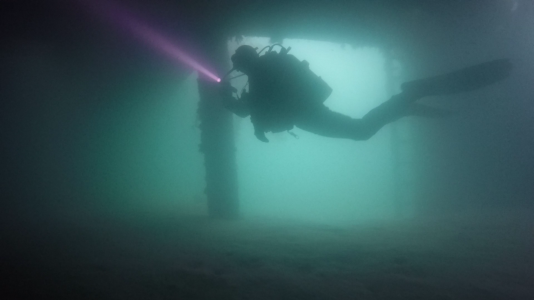
Due to the long tradition of shipping in the Lough it is not surprising
that its bed is carpeted with wrecks. It has been referred to as the Scapa
Flow of Northern Ireland, with wrecks of all shapes and sizes spanning
the last one hundred years. Wreck divers may be interested to learn that
the bell from the Tiberia, a major liner, was located only a few years
ago.
The visibility in Belfast Lough ranges from 3-10m. Some 20 wrecks can
be dived in Belfast Lough. These
wreck dives vary in difficulty, with something for all abilities. Dive
depths are from 10m to over 60m.
For divers keen to look for new wrecks there are some four hundred named
wrecks off the Northern Ireland coast, many of these in the Irish Sea.
Strangford Lough
|
Strangford is the largest sea inlet in the British Isles with a
meandering shoreline of 15O miles. This gigantic inland sea, has
about 120 small islands and is surrounded almost entirely by land.
This means there is an enormous diversity of easily accessible diving
sites. Quite simply, Strangford Lough is unique, a marine biologist's
paradise. Strangford boasts some 15 divable
wrecks.
The Lough is connected to the sea by a long narrows where the sea
is usually flat and calm. This belies the fierce currents of up
to 8 knots and depths of 80 metres which can make this as adventurous
a dive as anyone could wish for. Sheer cliffs are covered by luxurious
growths of dead men’s fingers and big sponges which, even at slack
water, makes the dive exciting.
|
|
|

|
The appeal of the Lough to marine biologists is its
very wide range of seabed conditions, influenced by water movements
and the enormous diversity of species which are found.
The life on the seabed and around the many wrecks
is varied and prolific with urchins, anemones, sea squirts, scallops,
crabs, prawns and even octopus. The scampi prawn is common in the
Lough and can often be seen on the mud or outside its burrows.
|
|
There is one species of large sponge which was described to science
from specimens collected in Strangford. Undoubtedly though, one
of the richest marine life communities is based around the big horse
mussels. Its colonies provide a stable attachment for many other
species including scallops. Many people believe these beds to have
been in place undamaged for hundreds of years.
The variety of marine life and good visibility, 4-l0 m plus, make
Strangford Lough an excellent site for underwater photography.
|
 |
|