|
HSE SCUBA TRAINING PROGRAM

DV Diving offers the HSE SCUBA qualification through a modular training
program. A combination of prescribed modules form our Commercial SCUBA
course. The Health and Safety Executive (HSE) have inspected and approved
the training and assessment given during this course and upon successful
completion of the required modules, students will be issued, by the HSE,
with a HSE SCUBA diver qualification.
The HSE SCUBA diving certificate is an Approved Diving Qualification
under the Diving at Work Regulations 1997 (DWR). The possession of an
Approved Diving Qualification is a legal requirement in the UK to undertake
any commercial diving activity. In particular HSE SCUBA satisfies the
requirement of the Media, Shellfish, Scientific and Archaeological and
Inland/Inshore Approved Codes of Practice (ACoP).
No previous diving qualification or experience is required to undertake
the full HSE SCUBA course. However, the modular format of the course can
give credit for recreational diver qualifications already achieved. This
is known as Prior Learning and Competence Assessment (PLCA). Your current
recreational certification is assessed against the required diver competence
at that level. The higher the level of recreational certification, the
less training is required. You will however be required to demonstrate
current competence in the skills appropriate to the level of certification
you currently hold. If competence is not demonstrated you would be required
to undertake additional training and assessment before proceeding with
the next module on the HSE SCUBA course. This is particularly relevant
where there has been a period of diving inactivity.
DV Diving's Training Programme
PREREQUISITES
Before starting the HSE SCUBA Training Programme students must hold a
valid HSE certificate of Medical Fitness to Dive. This must be valid for
the duration of the course. Students undertaking HSE SCUBA training must
organise their own diving medical. This must be carried out by a HSE approved
Medical examiner. You should undertake the medical well in advance of
the start date of any course. This medical typically costs between £140
and £180. A current list of approved medical examiners of divers
may be obtained from either the HSE or DV Diving.
The HSE First Aid at Work (FAW) and O2 Admin can be provided by DV Diving
or they may be attained through any other approved training organisation.
ACKNOWLEDGEMENT OF PRIOR TRAINING
The following table lists the qualifications of the major recreational
diving agencies. Your current diving qualification will determine your
entry level into the HSE scuba course.
| |
PADI |
CMAS/CFT |
SAA |
BSAC |
SSAC |
NAUI |
| Level 2 |
Open Water Diver |
1 Star |
Open Water Diver |
Ocean Diver |
Trainee Diver |
SCUBA Diver |
| Level 3 |
Advanced Open Water |
1 Star |
Club Diver |
Sports Diver |
3rd Class Diver |
Master SCUBA Diver |
| Level 4 |
Rescue Diver |
2 Star |
Dive Leader |
Dive Leader |
|
|
| Divemaster |
3 Star |
Dive Supervisor |
Advanced Diver |
2nd Class Diver |
Divemaster |
| |
4 Star |
Divemaster |
1st Class Diver |
1st Class Diver |
|
When recreational qualifications are to be used as evidence of prior
training, proof of certification is required. This will normally be in
the form of certification cards and/or logbooks. Prior learning will exempt
you from some training sections of the program. However, all students
must pass the required competencies at each stage. This results in four
entry levels to the program:
No previous qualification
You are required to complete all training and assessments on each required
module.
Level 2
PADI Open Water Diver (or equivalent):
You are required to pass Open Water skills assessments then complete all
training and assessments on subsequent modules.
Level 3
PADI Advanced Diver (or equivalent):
You are required to pass Open Water and Advanced skills assessments then
complete all training and assessments on subsequent modules.
Level 4
PADI Rescue Diver or Higher (or equivalent):
You are required to pass the Open Water, Advanced and Rescue skills assessments
then complete all training and assessments on subsequent modules.
COURSE COSTS
The overall cost of training will depend upon the entry level of the student
and any optional modules chosen. Deductions are applied to the course
fee for qualifications already held by the applicant.
Invoices will be issued prior to the start of the course. A deposit of
50% is payable on booking to confirm your place. Invoices for the outstanding
course fees are issued 60 days before the start date. Cancellation for
whatever reason within 60 days of the start date will result in the loss
of 50% of the deposit paid. The course deposit is not refundable if cancellation
is received less than 30 days before the start date, it may at our descretion
be transfered to a future course date.
The table below shows the duration and the cost of each module if taken
individually and the credit to be deducted from the full course fee if
the qualification is already held. In total the full HSE SCUBA course
consists of 5 weeks of training and assessment and costs £3,165.00.
A discount may be applied when 4 or more students book and complete the
full training course together.
| Type of module |
Course Module |
Duration in Days |
Cost if taken Individually |
Deduction if Already held |
Required
|
|
| PADI Open Water Diver |
5 |
£520 |
100% |
| PADI Advanced Open Water Diver |
3 |
£290 |
100% |
| PADI Rescue Diver |
3 |
£290 |
50% |
|
HSE SCUBA training & assessment
Compression Chamber Operations
|
10
1
|
£1350
£150
|
N/A
100%
|
| HSE First Aid at Work (FAW) |
4 |
£365 |
100% |
| Oxygen Administration |
1 |
£100 |
100% |
| Nitrox Diver |
1 |
£100 |
100% |
| Optional |
RYA Level 2 Powerboat Certificate |
2 |
£175 |
| RYA Advanced Powerboat Certificate |
3 |
£350 |
| RYA Sea Survival Course |
1 |
£150 |
| Marine Radio Operation |
1 |
£95 |
| TDI Advanced Nitrox |
3 |
£255 |
| TDI Nitrox Blender |
1 |
£150 |
| TDI Service Technician |
3 |
£255 |
| TDI Decompression Proceedures |
3 |
£295 |
HSE SCUBA Course Content information
Theory Syllabus
There are three multiple choice question papers that make up the theory
assessment. The papers cover Diving at Work, SCUBA Diving and USN decompression
Tables. Students will attend a comprehensive series of lectures and tutorials
to cover material in the following areas. It may be helpful for students
to review the course notes prior to attendance, especially when their
first language is not English.
Diving at Work
Diving Project Plans & Risk Assessments.
Physics (gas laws, air & water characteristics)
Diving injuries & illness (barotrauma, decompression sickness, gas
toxicity)
Basic Physiology
Communications (acoustic & hard-wire voice communications, rope signals,
hand signals)
Equipment (air purity tests, compressors, filters, cylinders, regulators,
nitrox etc)
Health & Safety at Work (employer/ee requirements)
Diving at Work Regulations 1997, Codes of Practice & other relevant
legislation (responsibilities of supervisors, divers and others, equipment
testing, British Standards, HSE, DMAC, IMCA etc)
Underwater Work, high-risk environments, inspection, searches, lifting
and survey techniques.
Diving procedures and their implementation.
Scuba Diving Theory
Scuba equipment (design, manufacture, function, care, pre-dive checks,
faults, maintenance and testing)
Scuba techniques (equipment configurations, air consumption, entry/exit
to water, navigation, standby divers (on-surface & in-water), decompression
stops, emergency procedures)
Recompression chambers (basic design, operation, checks etc). Includes
a chamber dive to 40m.
Decompression Tables
Decompression theory
Types and use of tables including calculation of dive schedules, planning
and decompression.
Dive computers
Practical
The practical schedule is arranged so that students will initially receive
training prior to repeating the tasks under more formal assessment. The
assessments are competence based. This means that a student is required
to demonstrate an acceptable level of performance of all skills and abilities.
Certain skills are required to be performed a number of times during the
duration of the course. Some of the most important attributes required
for successful completion of the course are a good professional attitude
and teamwork abilities. Students will receive continual feedback on their
performance through post dive de-briefs and periodic informal individual
progress reviews.
As a guide to the scope of activities that will be covered throughout
the course, listed below are some of the categories of competence.
Check and prepare equipment for a SCUBA diving operation
Dress correctly ready for entering the water for a SCUBA diving operation
Assist another diver to dress correctly ready for entering the water for
a SCUBA diving operation
Assist the Supervisor in the preparation of a work plan for a SCUBA diving
operation
Have knowledge of the pre-dive procedures for a two compartment compression
chamber
Dive in open water to a maximum depth of 30m using SCUBA diving equipment
Particular operational techniques used for prevailing conditions.
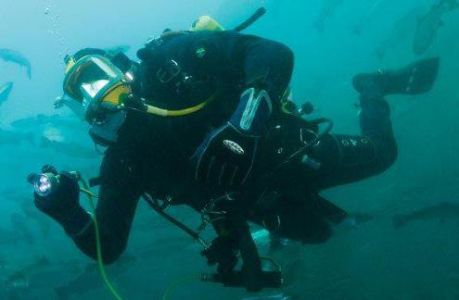
Use a variety of SCUBA equipment configurations used commercially, including:
Half mask and mouthpiece
Ocean Reef Full Face Mask
Poseidon Full Face Mask
AGA Full Face mask (positive pressure)
Dry suit with suit inflation.
Dry suit with suit inflation and buoyancy compensator.
Hard wire voice communications system
Through water voice communications system
Use SMB's DSMB's and lifelines
Independent twin cylinder air supply systems or manifolded air supply
systems
Reduced visibility- less than 0.5 m
Different bottom types: shingle/sand/mud
Mid water in moderate currents (approx. 0.5 knots)
Night dives
Approximately 40 dives will be undertaken on the full SCUBA module to
a maximum depth of 30m.
Use decompression procedures
Act as a diver's tender in a SCUBA diving operation
Undertake a compression chamber dive to 40 metres (when possible)
Functions and procedures for operating a multiplace recompression chamber
Functions and procedures for acting as an attendant inside a multiplace
recompression chamber
Use, inspect and maintain compressors and air purity analysis
Knowledge of the conduct of a therapeutic recompression
Undress correctly on completion of a SCUBA diving operation
Assist another diver to undress correctly on completion of a SCUBA diving
operation
Carry out post dive equipment checks.
Decontaminate and clean equipment
Ensure proper care and storage of equipment
Have knowledge of the post dive compression chamber checks and user maintenance
Conform to statutory requirements.
Conform to general requirements.
Maintain health and safety of individuals and others.
Assess and establish the need of a diving casualty.
Give first aid and take emergency actions.
Assist in treatment of diving related ill health condition/ illness.
Establish and maintain effective work relationships with dive team.
Contribute to effective teamwork.
Tutorials and lectures will be undertaken to cover aspects of commercial
of SCUBA not already covered during recreational training. These will
include topics such as equipment configuration, maintenance and recompression
chamber operations
The practical training includes commercial equipment familiarisation
and operation through a wide range of underwater tasks, providing students
with experience in working underwater, under a range of conditions. These
tasks may include seabed survey exercises that incorporate voice communications,
rope signals, lifting operations, photography and video. Training may
also include a dry dive to 50m in a recompression chamber. The practical
component of the course is continually assessed through competence assessment.
To successfully complete the SCUBA course, students must demonstrate an
acceptable level of competence and must be able to work efficiently, safely
and as a team member.
|